

NASA Powers Down Voyager 1 Instrument to Stretch Decades‑Long Mission

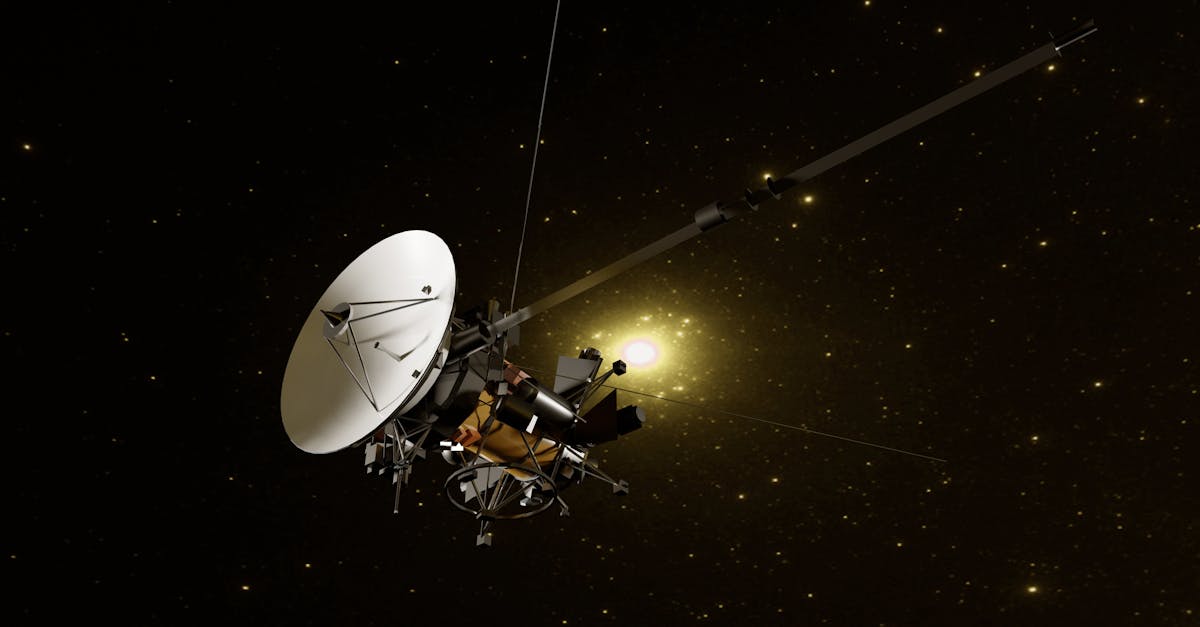
Photo by Paul Seling on Pexels
Power Cut on a 45‑Year‑Old Probe
NASA disabled a non‑essential sensor on Voyager 1 on 17 April 2026, citing the spacecraft’s shrinking plutonium‑powered electricity budget. The move protects the probe’s core navigation and communications gear, which must stay alive to continue sending interstellar data. With the radioisotope thermoelectric generators (RTGs) delivering less than 200 watts—about a third of the original output—every watt counts.
The instrument, part of the suite that monitors cosmic‑ray flux, was identified as expendable after a review of science priorities. Its shutdown reduces the total load by a few watts, extending the lifetime of the high‑gain antenna and the onboard computer. Engineers recalibrated power‑distribution software to reroute the saved energy to the transmitter, ensuring the weak signal can still reach Earth’s Deep Space Network.
The Aging Powerhouse and Its Legacy
Voyager 1’s RTGs have been decaying at roughly 0.8 % per year since launch in 1977. The original design assumed a 30‑year operational window, yet the probe has outlived expectations by nearly two decades. Its continued relevance stems from the unique measurements of plasma density, magnetic fields, and particle flux in interstellar space—data no other mission can replicate.
The power crunch forces a hard trade‑off between legacy science and mission survival. NASA’s decision reflects a pragmatic stance: preserve the telemetry link over incremental science returns. This mirrors earlier choices on Voyager 2, where the plasma wave instrument was turned off in 2023. The pattern reveals a broader reality for deep‑space explorers: once the power source wanes, mission managers must prioritize data that cannot be obtained elsewhere.
Looking Ahead: Self‑Regenerating Shields and Bio‑Inspired Tech
The radiation environment that Voyager endures is the same hazard that drives research into radiotrophic fungi. Experiments aboard the ISS showed that a 1.7 mm mat of Cladosporium sphaerospermum attenuated ionizing radiation by roughly 2 % and grew 21 % faster in microgravity. While the shield’s effect is modest, the principle of a living, self‑repairing barrier could inform future long‑duration probes.
If a spacecraft could cultivate a thin fungal layer on its hull, the organism would continuously replenish melanin‑rich cells, offering passive protection without additional mass. Such bio‑ISRU (in‑situ resource utilization) aligns with NASA’s roadmap for crewed Mars missions, where payload mass is at a premium. The Voyager shutdown underscores that even a modest power saving is valuable; a self‑healing shield could reduce the need for heavy, active radiation shielding, freeing power for scientific payloads.
Cultural Echoes: Asimov’s Vision and Modern Space Playgrounds
Isaac Asimov’s 1964 predictions about unmanned Mars landers and laser‑based Earth‑Moon communications have become textbook examples of speculative accuracy. Voyager’s continued operation validates his view that “robots will neither be common nor very good in 2014, but they will be in existence.” The probe is the ultimate robot—an autonomous envoy sending data across 24 billion kilometres without human intervention.
The fascination with deep‑space exploration also fuels community projects like the open‑source game Naev, which lets players pilot ships through a procedurally generated galaxy. Naev’s developers invite contributors to craft mission narratives, mirroring the real‑world challenge of designing science objectives for a power‑constrained craft. Both the game and Voyager illustrate how storytelling and engineering converge when humanity pushes beyond Earth’s cradle.
What to Watch
NASA’s next power‑budget review will likely target another low‑priority sensor, tightening the margin for future data. Simultaneously, the radiotrophic‑fungus concept is moving toward ground‑based scalability studies; a successful demonstration could reshape shielding strategies for the Europa Clipper and Artemis habitats. Keep an eye on budget hearings and peer‑reviewed papers on bio‑shielding—each will signal how the space community balances legacy missions with next‑generation resilience.
Updates
- 2026-09-03 — Nvidia’s new RTX Spark laptops launch in October with two different configs (source)
- 2026-05-07 — Bumble will replace swiping right with… something (source)
- 2026-04-30 — Germany has become the largest ammunition producer in the world (source)
- 2026-04-25 — Trump fires the entire National Science Board (source)
Related Articles
Microsoft, Lyft, Samsung and Honor Shift Audience and Device Play
Microsoft pushes fan-community features, Lyft trains drivers to service Waymo fleets, Samsung advises Apple on foldables, and Honor’s robot phone sparks niche demand.

DoD disables ad tracking on soldiers after hostile location
The Pentagon halted advertising IDs on service members' phones after intelligence linked location data to enemy attacks, raising privacy and security stakes.

Hyperloop Test Track Breaks Ground as Uber Rolls Out London
Hyperloop Transportation Technologies begins building a five‑mile test tube in Quay Valley while Uber launches supervised robotaxis in London, highlighting a new wave of autonomous transport.